B Appendix B: C Definitions for R Base Types
A fundamental understanding of R base types requires consideration of C-API code that underlies R itself. The R base type framework is codified in a series of internal C header files (see Section 9.5.1.3), including Defn.h, Rinternals.h and R.h, some of which will remain available in \R\R-version\include\ (Windows machines), after R is built on your computer. All R source code, including header files, can be accessed at https://github.com/wch/r-source/tree/trunk/src. The file Rinternals.h can be revealed in R using: path <- file.path(R.home("include"), "Rinternals.h"); file.show(path). Three important C entities are referred to or defined in Rinternals.h208: SEXP, SEXPTYPE, and SEXPREC (Fig B.1). All processes for all R objects are underlain by SEXP, SEXPTYPE, and SEXPREC.
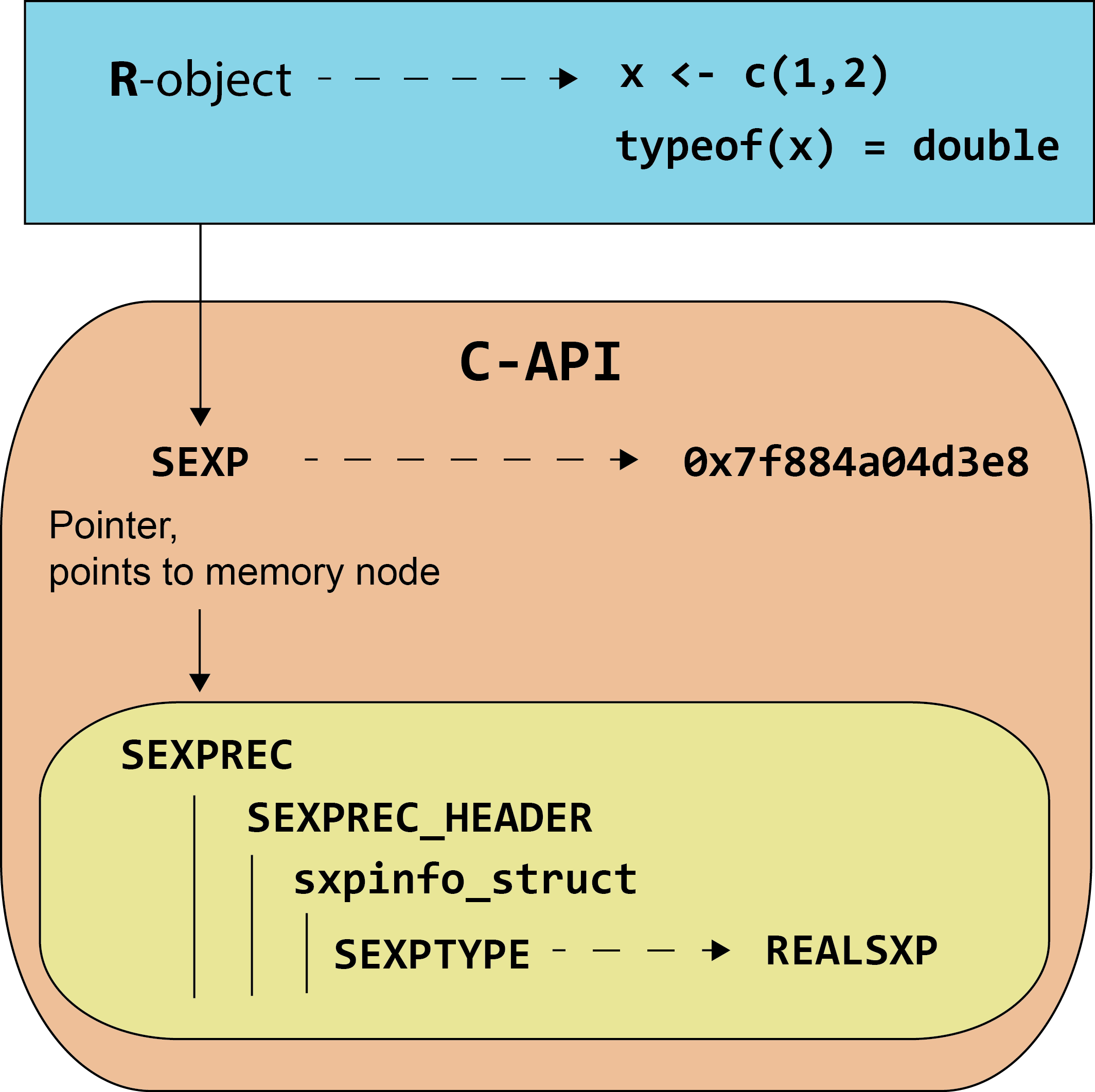
FIGURE B.1: Relationship between R object base types and C-API processes. The R object x of base type double is created. In the R C-API, x is allocated to an SEXP pointer with address 0x7f884a04d3e8. The SEXP points to an SEXPREC with the SEXPTYPE, REALSXP.
- An
SEXP(S-expression) serves as a pointer (a variable that stores the memory address of another variable) for anSEXPREC(Fig B.1). The relationship betweenSEXPandSEXPRECis codified on Line 186 inRinternals.hwhich reads:
-
In the code above,
typedef creates an C alias framework. Specifically, SEXP is defined to be an alias and a pointer (indicated with the * prefix) for SEXPREC, a C data structure (defined with struct) that groups entities.-
SEXPTYPEs (S-expression types) are C data type reference names that correspond to the 24 R base types (Section 2.4.8)209.SEXPTYPEs (e.g.,NILSXP,SYMSXP,REALSXP, etc.) are grouped and numbered in a typedef beginning on Line 109 inRinternals.h, with the codetypedef unsigned int SEXPTYPE;which allowsSEXPTYPEs to be identified using unsigned integers.
-
SEXPRECs (S-expression records) codify the C data holding structures for all R objects. TheSEXPRECframework is comprised of several distinct components defined in the header fileDefn.h210. These components includesxpinfo_struct, a 64 bit (Section 12.4) metadata structure, defined on Lines 130-149:
struct sxpinfo_struct {
    SEXPTYPE type      :  TYPE_BITS;
    unsigned int scalar:  1;
    unsigned int obj   :  1;
    unsigned int alt   :  1;
    unsigned int gp    : 16;
    unsigned int mark  :  1;
    unsigned int debug :  1;
    unsigned int trace :  1;
    unsigned int spare :  1;
    unsigned int gcgen :  1;
    unsigned int gccls :  3;
    unsigned int named : NAMED_BITS;
    unsigned int extra : 32 - NAMED_BITS;
}; /*           Tot: 64 */
Components of sxpinfo_struct are discussed in R Core Team (2024a), Section 1.1.2. Of particular interest, the code SEXPTYPE type : TYPE_BITS; 1) identifies an object’s SEXPTYPE (given in type, which in turn is pulled from definitions in the SEXPTYPE typedef), and 2) defines the number of allocated bits (given in TYPE_BITS).
SEXPRECs is a C preprocessor macro that incorporates sxpinfo_struct and three pointers (to the attributes of the current node/object, and to the previous and next node), and serves as a header for every SEXPREC:#define SEXPREC_HEADER \
struct sxpinfo_struct sxpinfo; \
struct SEXPREC *attrib; \
struct SEXPREC *gengc_next_node, *gengc_prev_node-
A union of this header and the node data itself is codified as:
typedef struct SEXPREC {
    SEXPREC_HEADER;
    union {
    struct primsxp_struct primsxp;
    struct symsxp_struct symsxp;
    struct listsxp_struct listsxp;
    struct envsxp_struct envsxp;
    struct closxp_struct closxp;
    struct promsxp_struct promsxp;
    } u;
} SEXPREC;-
Notably, vector entities (those with C
SEXTYPEs: REALSXP, INTSXP, CPLXSXP, LGLSXP, STRSXP, RAWSXP (i.e., atomic vectors), VECSXP (general (list) vectors), EXPRSXP (expression vector), CHARSXP (internal character strings, i.e. STRSXP references in the R global string pool (see Section 3.10.1)), and WEAKREFSXP (internal weak references) have their own SEXPREC framework called a VECTOR_SEXPREC (see Lines 222-225 in Defn.h). Details concerning the characteristics of data for particular SEXTYPEs are given in R Core Team (2024a), Section 1.1.3.Throughout its content, Rinternals.h code reveals strong ties to Lisp/Scheme structures (despite being written in C). The use of the term SEXP indicates a structure analogous to a Lisp S-expression. Additionally, car and cdr stand-ins are defined and used as cons cells, and an nil object is created (see description of Lisp in Appendix A):